
How we Co-write Our Books
S. A. Reeves is a co-writing partnership between my wife, Amanda, and me. I have written about the origin story of S. A. Reeves and the Bookshop Mysteries in a separate post, but in this post I want to talk specifically about our writing process.
As a writing partnership, what we both DON’T do is sit in front of the same computer and write together as that would get very tiring very quickly and would not be fun. Instead, we split the workload based on our skills and the time we can dedicate to writing. For me, Stephen, I am fortunate to write full time. Amanda has a nine-to-five career for a company she has been with for over twenty-five years, so our workload on S. A. Reeves is split accordingly.
First, let’s start with shared tasks that we both do together, and they are probably the most important, as without them there would be no book. Together, we work on plotting and subplots, character development, the settings, and planning ahead for the series. A lot of our planning happens on long car drives, hikes in the countryside (Derbyshire), or on the sofa in the evenings if one of us has an aha moment. Most of our best ideas have come to us spontaneously, which we then brainstorm to tease out the details.
As I (Steve) work on this full time, it makes sense that I do the majority of the drafting side of the books. With our plot, characters, and settings decided, I will begin to write the first draft of the book. I either write directly into Scrivener, or I dictate the chapter, depending on my mood. I used to dictate a very rough draft of a chapter directly into Scrivener, but I have moved over to a system called Plaud. Plaud is a small recording device I speak into, and then the chapters are transcribed into text. I use those transcriptions as a starting point to complete the chapter draft.
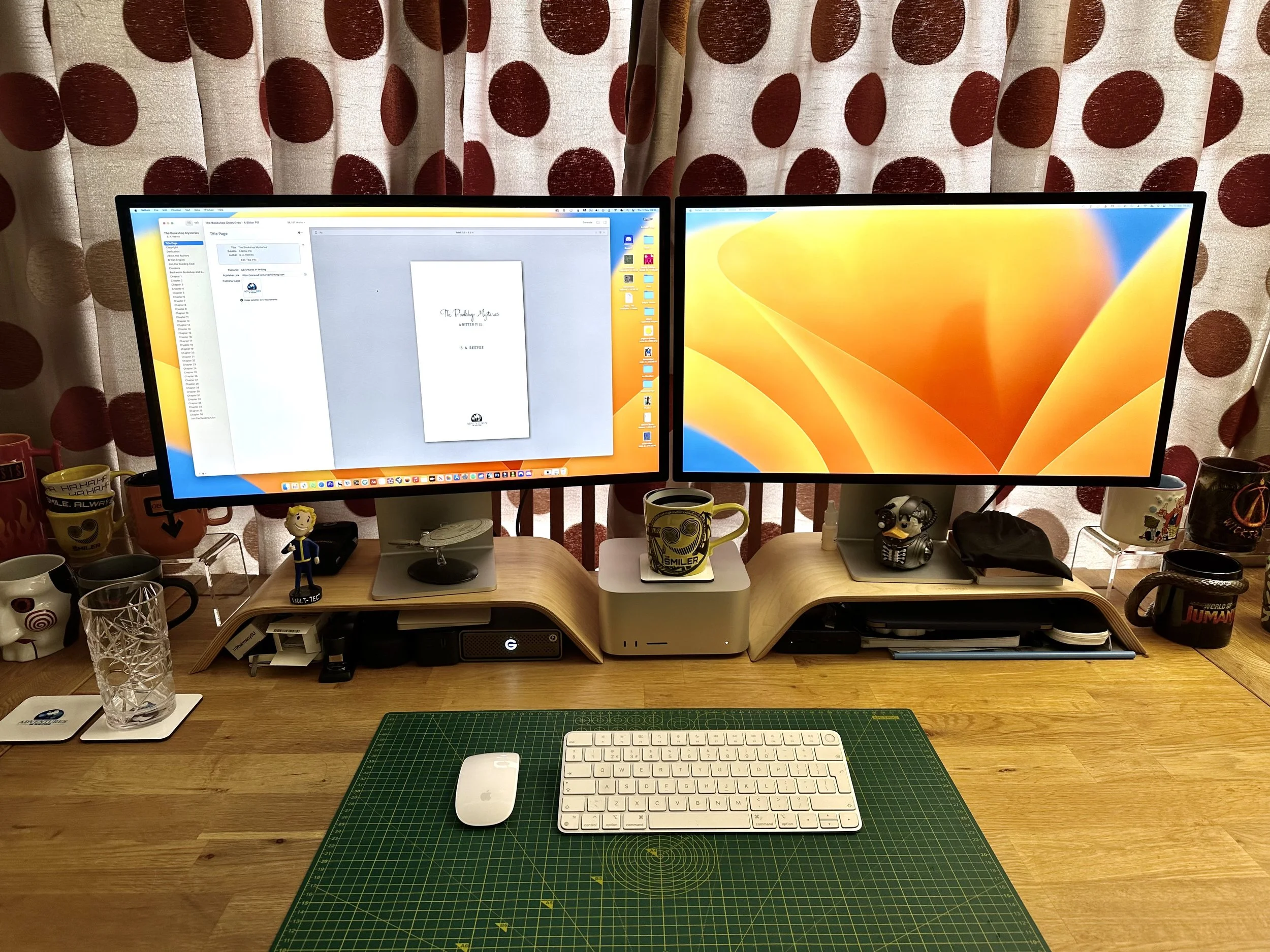
The writing desk of S. A. Reeves
I switched to using Plaud on the recommendation of another writer who was speaking at this year’s Self Publishing Live conference. The reason I want to use it is because I will have the original timestamped audio files for each chapter as well as the initial text transcript. This is quite important these days as writers need to be able to prove they wrote their own books.
I switched to Plaud for the final nine chapters of MMS Book 1, and I was seven chapters into Bookshop Mysteries 7 - A Ring of Roses when I switched. The topic of proving a book’s authorship is a big subject on its own at the moment, so I will save that for another post where I will go through our process.
I edit the chapters as I go along, which involves reading the chapter several times and then running it through a tool called ProWritingAid where I run their grammar and style reports. It’s quite unusual for writers to edit as they go along, but Amanda’s time is precious, so I want to make sure what I give her to read is of a reasonable quality.
When I am happy with a chapter, I print it out and put it in Amanda’s folder, and she will read through it to make sure the chapter makes sense, fix any errors, and also change wording to reflect her voice. Also, as Amanda is a woman, she is making sure the women characters are well represented. This is a vital part of the process and is what gives us the S. A. Reeves voice. Amanda prefers to edit on paper with a red pen. When I get the chapter back, I go through her changes and manually apply them in Scrivener. This does slow the process down, but doing this manually makes me really think about the changes. We did discuss Amanda using track changes in Word, but because she is on a computer all day for her day job, she would rather not edit on a screen, which is fair enough. To be honest, being forced to slow down for a manual process like this makes for a better book.
We iterate like this until we have a complete book. Then I read the book through a couple of times and make sure everything makes sense, and when that is done, I send it to our editor. I enjoy this part of the process as we are getting input from someone who is an expert but not familiar with the book, which is a vital part of the process.
When the manuscript comes back from the editor, I go through all their suggested changes and make sure they are merged back into the master document in Scrivener. I then read the book again, and if I am happy, it is then proofread. Then I format the book as an ebook, paperback, and hardback. I use a tool called Vellum for this. At that stage I know how many pages the book will be, so I can ask our cover designer to adjust the cover files with the correct spine width.
Once that is done, we get ready for release, which involves marketing and promotion. Again, that is a large subject, so I think I’ll leave that for another blog post.
Writing a book in a partnership like this has been a lot of fun, and we are both proud of the books we have written. I would say the key to successfully coauthoring a book is to really look at both of the writers’ skill sets and time availability and use that to plan your process. You don’t need to have both of you writing chapters, but some partnerships write that way. For us, the shared tasks of plotting, planning, and character development are where the magic happens, and we then use our skills to work on the book chapter by chapter.
Our writing process hasn’t really changed since we wrote A Bitter Pill, and I don’t see it changing anytime soon. If it works, then you don’t need to fix it.